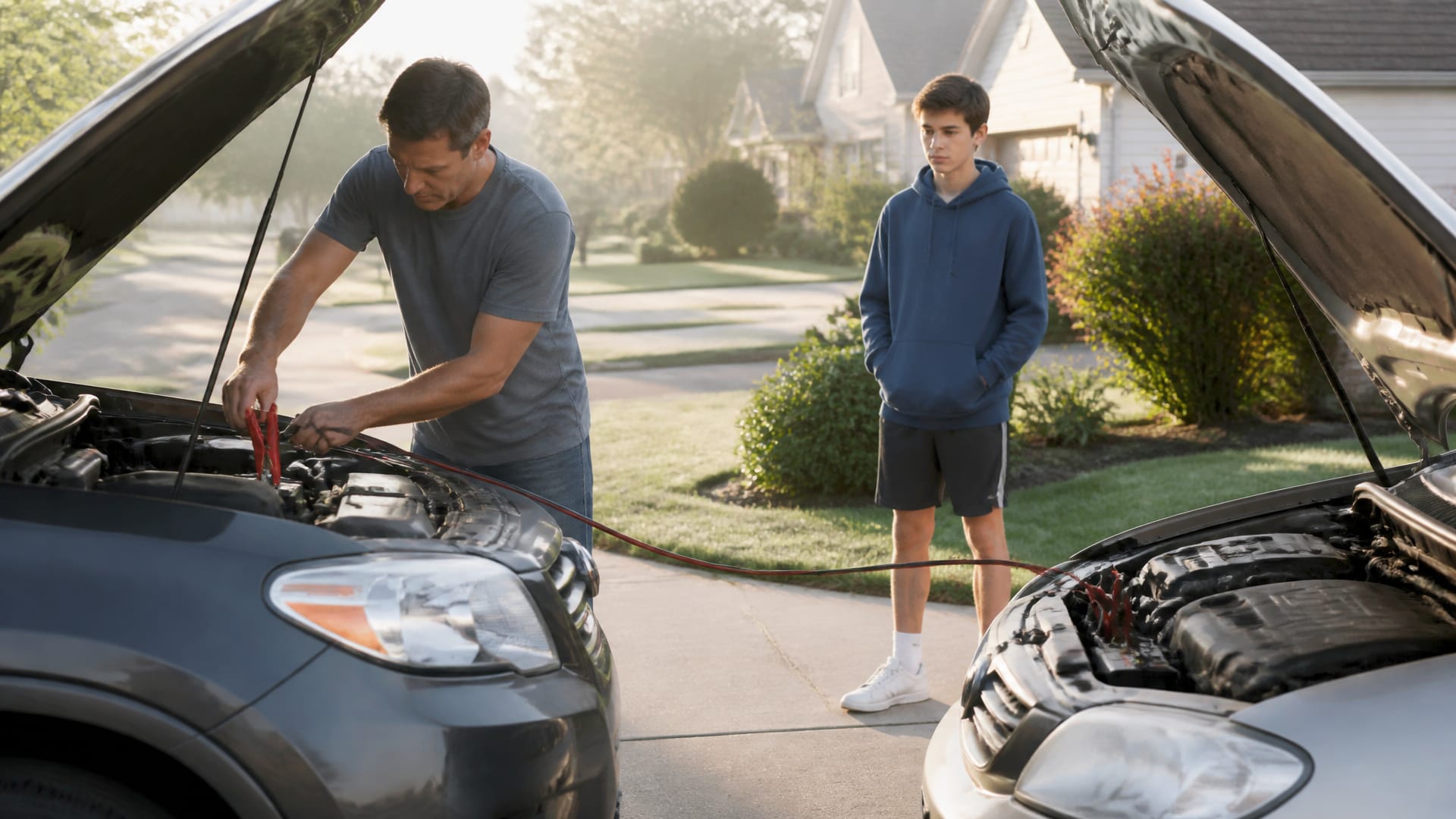
A dead battery has a way of showing up at the worst time - before school drop-off, right before a work shift, or when you’re already running late for groceries. If you’re searching for how to jump start a car battery, the good news is that the process is usually simple once you know the order and the safety basics. This guide explains how to jump start a car safely, what order do jumper cables go on, and how to tell whether you’re dealing with a dead battery, a different problem, or a car won’t start battery or alternator issue.
It also covers the parts people skip too fast: hybrid cautions, when a battery is too dead to jump, and what to do after jump starting a car so you don’t end up stranded again. If you’ve ever wondered, “How do I jump-start a dead car battery?” or “How long should I drive after jump-starting?”, you’re in the right place.
Quick Reference
- Park both cars in neutral or park, with engines off.
- Connect red to dead battery first, then red to good battery.
- Connect black to good battery, then black to bare metal on the dead car.
- Start the working car first, then the dead car.
- If the car still won’t start, stop and check for a bigger problem.
Top Questions Answered
What order do jumper cables go on?
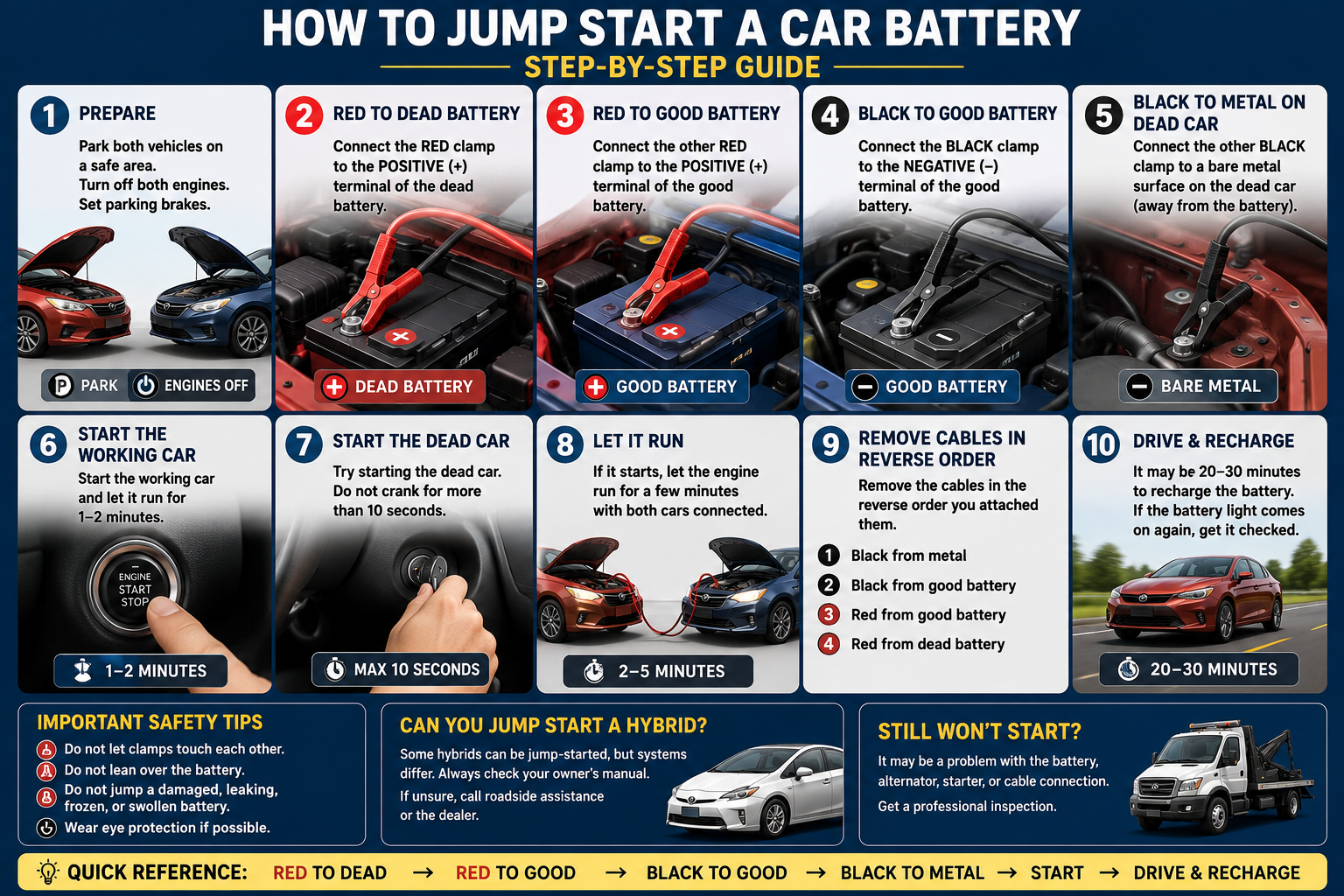
The safest jumper cable order matters because a wrong connection can cause sparks or damage. AAA’s jump-start guidance recommends this basic sequence for a standard 12-volt vehicle: red clamp to the positive terminal of the dead battery, red clamp to the positive terminal of the good battery, black clamp to the negative terminal of the good battery, and the last black clamp to an unpainted metal surface on the dead car, not the dead battery itself. That last ground point helps keep sparks away from the battery.
Before you clip anything, make sure both vehicles are off, in park, and set with the parking brakes on. Keep the clamps from touching each other while they’re attached. If the battery is cracked, leaking, swollen, or smells strongly like rotten eggs, do not try to jump it. That can mean the battery is damaged and unsafe to use.
Takeaway: Red to dead, red to good, black to good, black to metal on the dead car.
How do I jump-start a dead car battery safely?
First, gather proper battery cables and confirm both vehicles use the same general 12-volt system. Most cars and small trucks in the U.S. do, but a few vehicles are different. Put the cars close enough for the cables to reach, but don’t let them touch. Turn off lights, radios, phone chargers, and climate controls in both vehicles. That reduces extra load on the system.
After the cables are connected in the right order, start the working car and let it run for a minute or two. Then try the dead car. If it starts, let both vehicles sit connected for a short time, then remove the cables in reverse order. If the dead car only clicks, cranks very slowly, or starts and dies again, the problem may be bigger than a weak battery. The explore more Vehicle Care & DIY Maintenance Checklist tips page has related upkeep ideas for readers who want to stay ahead of common breakdowns.
If you are learning how to jump start a car safely for the first time, keep your hands and face away from the battery as much as possible. Experts generally agree that a careful setup matters more than speed.
Can you jump start a hybrid car?
Yes, some hybrids can be jump-started, but the caution level is higher. The reason is simple: a hybrid has more than one electrical system. The small 12-volt battery may be jump-started in some models, but the high-voltage drive battery is a separate system and should not be treated like a regular car battery. That’s why the owner’s manual is the best place to start.
Automakers often give exact jump points or special instructions for a hybrid. If the manual says not to jump the vehicle yourself, follow that advice. If you do not know where the correct jump terminal is, or if the car has orange high-voltage cables, stop and call roadside help or the dealer service line. A wrong connection in a hybrid can lead to expensive damage.
Tip: For hybrid jump-starts, the owner’s manual beats guesswork every time.
When is a battery too dead to jump?
A battery can be too dead to jump if it is damaged, frozen, leaking, or physically swollen. Cold weather can also make a weak battery harder to recover, especially after a long overnight sit. If the battery is several years old and keeps failing, a jump may only be a short-term fix. AAA notes that repeated no-start problems often point to a charging issue, a bad battery, or another electrical fault rather than a one-time drain.
Watch for signs that the problem is not just a dead battery: no dashboard lights at all, rapid clicking, smoke, corrosion that keeps coming back, or a car that starts with a jump but dies a few minutes later. That can point to the alternator, starter, battery cables, or another part of the charging system. If you have to jump the car more than once in a week, it’s time for a proper inspection.
When the battery case is cracked or leaking, do not try to force it back to life. Call roadside help or a shop instead.
What should I check after jump starting a car?
What to do after jump starting a car is just as important as the jump itself. Once the engine is running, let it idle for a few minutes and watch the dashboard. Check that warning lights are off, especially the battery light. Then turn on the headlights and confirm they stay steady instead of fading. If the car stalls when you remove the cables, the battery may not be holding a charge.
Next, think about where you’re going. A short drive is usually better than a long idle, because the alternator helps recharge the battery while you drive. Many drivers ask, “How long should I drive after jump-starting?” There isn’t one perfect number for every car, but a 20- to 30-minute drive is a common practical target for a healthy charging system. If the battery was deeply drained, that may still not be enough.
If the battery light comes back on, or if the car starts acting weak again, get the charging system checked soon. That can help you avoid another battery emergency.
How long should I drive after jump-starting, and what if it still won’t start?
After a successful jump, take the car on a steady drive if you can. Short stop-and-go errands may not recharge the battery very well, especially if you’re using the heater, defroster, lights, and phone chargers at the same time. A smoother drive gives the battery and alternator a better chance to do their jobs.
If the car still won’t start after a correct jump, don’t keep cranking it over and over. That can overheat the starter and drain the good battery too. Double-check the clamps, make sure they are tight, and confirm the connection points are clean metal. If everything looks right and the engine still won’t turn over, the issue may be the starter, alternator, ignition switch, or a loose battery cable. This is the point where roadside help or a mechanic makes more sense than repeated guessing.
For parents, commuters, and weekend errand-runners, a no-start in the driveway is annoying. On the shoulder of a busy road, it can become a safety issue fast. The National Highway Traffic Safety Administration emphasizes safe roadside behavior, including staying alert to traffic and using hazard lights when appropriate.
Quick Reference Summary
- Use the correct clamp order: red to dead, red to good, black to good, black to bare metal on the dead car.
- Keep both cars off while attaching clamps, and make sure they do not touch.
- Do not jump a cracked, swollen, frozen, or leaking battery.
- Be extra careful with hybrids and follow the owner’s manual.
- After the car starts, remove the cables in reverse order and watch for warning lights.
- Drive long enough to give the battery a chance to recharge, then get checked if the battery light returns.
- If the car won’t start again, the problem may be the battery, alternator, starter, or cable connection.
Final Thoughts
Learning how to jump start a car battery is one of those small skills that can save a stressful morning. The process is manageable if you slow down, follow the clamp order, and respect the warning signs. Hybrids need extra care, and damaged batteries should be left alone. After the engine starts, keep an eye on the dashboard and drive long enough to see whether the charge holds.
If the same battery emergency keeps happening, treat it as a clue, not just bad luck. A quick inspection can tell you whether you are dealing with a weak battery, a charging problem, or something else that needs professional help.
For more practical upkeep ideas, you can explore more Vehicle Care & DIY Maintenance Checklist tips.
External reference: AAA jump-start guidance and NHTSA roadside safety advice were used to support the safety steps in this article.
Comments
Post a Comment
💡 You don't need an account! Select "Name/URL" or "Anonymous" from the dropdown to post.