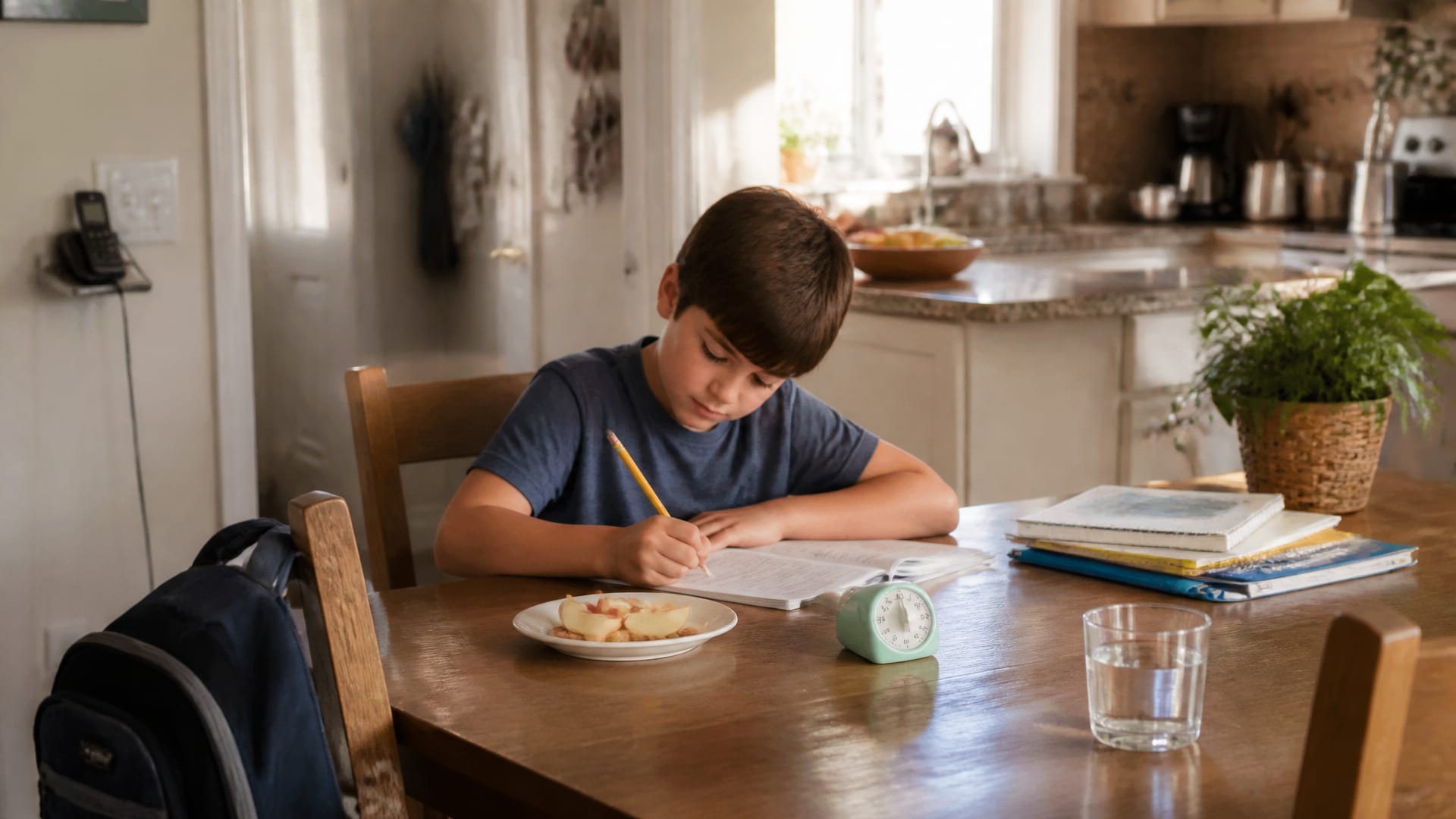
To master how to help kids focus on homework after school, avoid jumping straight into assignments the moment they walk through the door. Provide a 15- to 20-minute physical decompression window with a protein-rich snack, park all smartphones and gaming tablets in another room, and establish a dedicated homework station. Break tasks into manageable 10- to 20-minute timed intervals to establish a consistent after school routine that prevents emotional friction and cognitive fatigue.
How to Help Kids Focus on Homework After School
Start with a short reset, not a lecture. For how to help kids focus on homework after school, give them 15 to 30 minutes to eat, move, and clear their head, then move them to a set homework spot with the phone away and one task at a time. That simple after school routine usually beats kids homework focus battles, and it works better than jumping straight into homework help the second they walk in the door. If you need a quick answer to how to get kids to focus on homework after school, the fix is structure, not pressure.
Case Snapshot
- One high-protein snack first to replenish depleted cognitive glucose.
- Smartphones and gaming screens parked outside the study space.
- Homework begins at the identical operational window every weekday.
- Study blocks structured into focused 10- to 20-minute intervals.
- Proactive steps to reduce after-school homework battles before frustration sets in.
The best answer to what is the best homework routine for kids is usually the same one every weekday. Keep it boring. Keep it predictable. That is what helps a distracted child do homework without turning your kitchen into a standoff.
The American Academy of Pediatrics via HealthyChildren.org recommends establishing a predictable daily schedule and designated study environment (HealthyChildren: Helping with Homework). Clinical psychologists at the Child Mind Institute emphasize that shorter work blocks and removing digital notifications substantially improve executive functioning and task completion (Child Mind Institute: Homework Strategies for Parents). The CDC also points out that structured after-school routines bolster focus, especially when supported by balanced nutrition and a distinct mental transition between school and home. To discover related academic systems, explore more Early STEM Learning, Homeschooling Tools & School Success Hacks tips.
The Situation: After-School Mental Exhaustion
Picture a Tuesday in Columbus, Ohio, or maybe a wet March day in Atlanta. Your kid walks in at 3:45 p.m., drops a backpack by the couch, and says they have homework before soccer, piano, or the bus to daycare pickup. You are trying to make dinner. They are trying to decompress. Nobody has patience left.
That is the real problem with after-school assignments in a lot of American homes. The academic material itself may not be excessively hard, but the transition is. Children return home with depleted energy reserves, physical restlessness, and personal devices competing for attention. Nine times out of ten, friction occurs before a notebook is even unzipped.
Whether your child is a second grader facing a single reading log or a middle schooler balancing pre-algebra and science labs, environmental setup dictates the outcome. A designated workspace, out-of-reach chargers, and an intentional snack accomplish significantly more than repetitive verbal prompting.
If your household deals with sibling interruptions, sports equipment scattered by the entryway, or household noise, you are not failing as a parent. You simply need an optimized operational sequence.
The Problem: Brain Fatigue and Digital Distraction
Most homework resistance stems from three fundamental barriers: poor scheduling, unrestricted digital access, and zero transition time. Demanding that a child pivot immediately from a six-hour instructional day into independent seatwork ignores developmental biology. The developing brain requires hydration, caloric replenishment, and a brief motor reset.
Handheld mobile devices amplify this friction dramatically. Incoming notifications, short-form video feeds, and messaging apps shatter working memory. Getting back on task after a digital distraction requires substantial cognitive energy that tired children simply do not possess. Removing mobile devices entirely from the designated study zone prevents regular focus fragmentation.
Inconsistent physical workspace presents another hidden obstacle. Shifting work locations daily—from the family room couch to a breakfast bar or bedroom floor—prevents the brain from establishing contextual learning triggers. A designated station does not require custom furniture; a tidy dining table corner, adequate lighting, and an organized pencil caddy provide an effective structural baseline.
Parents often overestimate developmental attention spans during afternoon hours. A first or second grader generally sustains 10 to 15 minutes of uninterrupted focus, while older students thrive on 20-minute timed intervals followed by brief physical breaks. Expecting marathon study sessions inevitably produces procrastination, tears, and parent-child friction.
What We Tried: A Predictable After-School System
- We built a consistent after school routine: We established an unvarying operational order: unpack backpack, eat a balanced snack, use the restroom, and begin the first study block. Entertainment screens remained strictly off until all schoolwork was finalized.
- We set up a homework station: We gathered essential materials into a portable storage caddy containing sharpened pencils, erasers, a ruler, and highlighters. A basic desk lamp and an analog kitchen timer replaced digital phone timers to keep distractions out of sight.
- We instituted interval pacing: When learning how to help a distracted child do homework, we implemented a 10-minute focus burst followed by a mandatory 3-minute physical break (stretching, water, or walking). Video games and social streaming remained strictly prohibited during rest intervals.
- We removed material friction: Assignment folders, Chromebook chargers, and textbooks remained together in one location. Resolving missing supplies before starting sessions eliminated classic avoidance maneuvers.
- We implemented a device docking rule: All smartphones and personal media tablets were docked in a central charging basket in the hallway during study hours. Removing the physical presence of the device eliminated ambient notification anxiety.
We discovered that 15 to 20 minutes was the optimal decompression window. Shorter breaks resulted in crankiness, while extended breaks made transitioning back into an academic mindset considerably harder.
What Actually Worked
The most decisive improvement came from refining the transition window rather than giving repetitive reminders. Once nutritional needs and sensory decompression were met, beginning assignments felt markedly less punitive.
Displaying the schedule visually eliminated daily debates. We posted a clear sequence on a kitchen dry-erase board: Snack → Table → 15-Minute Timer → Physical Break → Bag Packed. Externalizing the schedule removed emotional friction between parent and child.
Replacing repeated interrogations ("Do you have homework?") with a single, scheduled afternoon check-in lowered household tension and supported independent accountability.
For children who feel overwhelmed, micro-stepping the initial action is exceptionally effective. Focusing solely on opening the workbook or solving the initial math problem lowers cognitive resistance, allowing momentum to carry the session forward.
Lessons You Can Use
- Provide a predictable 15- to 20-minute reset window after school dismissal before demanding study focus.
- Relocate smartphones and mobile devices to a separate room during scheduled study periods.
- Anchor study sessions to the same physical workspace every afternoon to reinforce mental focus habits.
- Offer nutrient-dense snacks containing protein and complex carbohydrates to stabilize blood sugar levels.
- Structure seatwork into 10- to 20-minute timed sprints rather than open-ended study blocks.
- Prepare all required stationery, chargers, and worksheets prior to starting the session timer.
- Maintain neutral, concise communication to avoid escalating everyday homework stress.
Parents can easily set up a homework station on a budget for under $50 using basic storage bins, standard task lighting, and an inexpensive mechanical timer. For homes with multiple children or ambient noise, basic over-ear hearing protection or noise-canceling headphones help maintain auditory focus without streaming media.
Frequently Asked Questions
How do I help my child focus on homework after school?
To implement how to help kids focus on homework after school, establish a predictable, repeatable routine: allow a 15- to 30-minute decompression period with a healthy snack, dock all smartphones in a separate room, and break assignments into short, timed working blocks to keep mental fatigue low.
What is the best homework routine for kids?
The best homework routine for kids follows a reliable sequence rather than an inflexible rigid clock: unpack gear, eat a protein snack, complete high-priority tasks in 15- to 20-minute sprints, take a brief 3-minute physical movement break, and repack materials into backpacks for tomorrow morning.
How can I reduce after-school homework battles?
To reduce after-school homework battles, eliminate ambiguity. Post a visual checklist on a whiteboard, use an analog timer rather than parent prompting to signal breaks, and ensure all pencils and supplies are positioned at the desk before the session begins.
How long should an elementary or middle school child spend on homework?
According to the National PTA and the National Education Association, the widely recognized standard is the "10-minute rule": roughly 10 minutes of total homework per night per grade level (e.g., 20 minutes for 2nd grade, up to 60–80 minutes for middle school students).
What You Can Do Tonight
Select one single modification for tomorrow afternoon: park all handheld screens in a hallway basket, set out an analog timer, and offer a protein snack before opening assignment folders. Establishing a repeatable system reduces household tension and provides your child with the foundation needed for independent academic success.
Comments
Post a Comment
💡 You don't need an account! Select "Name/URL" or "Anonymous" from the dropdown to post.