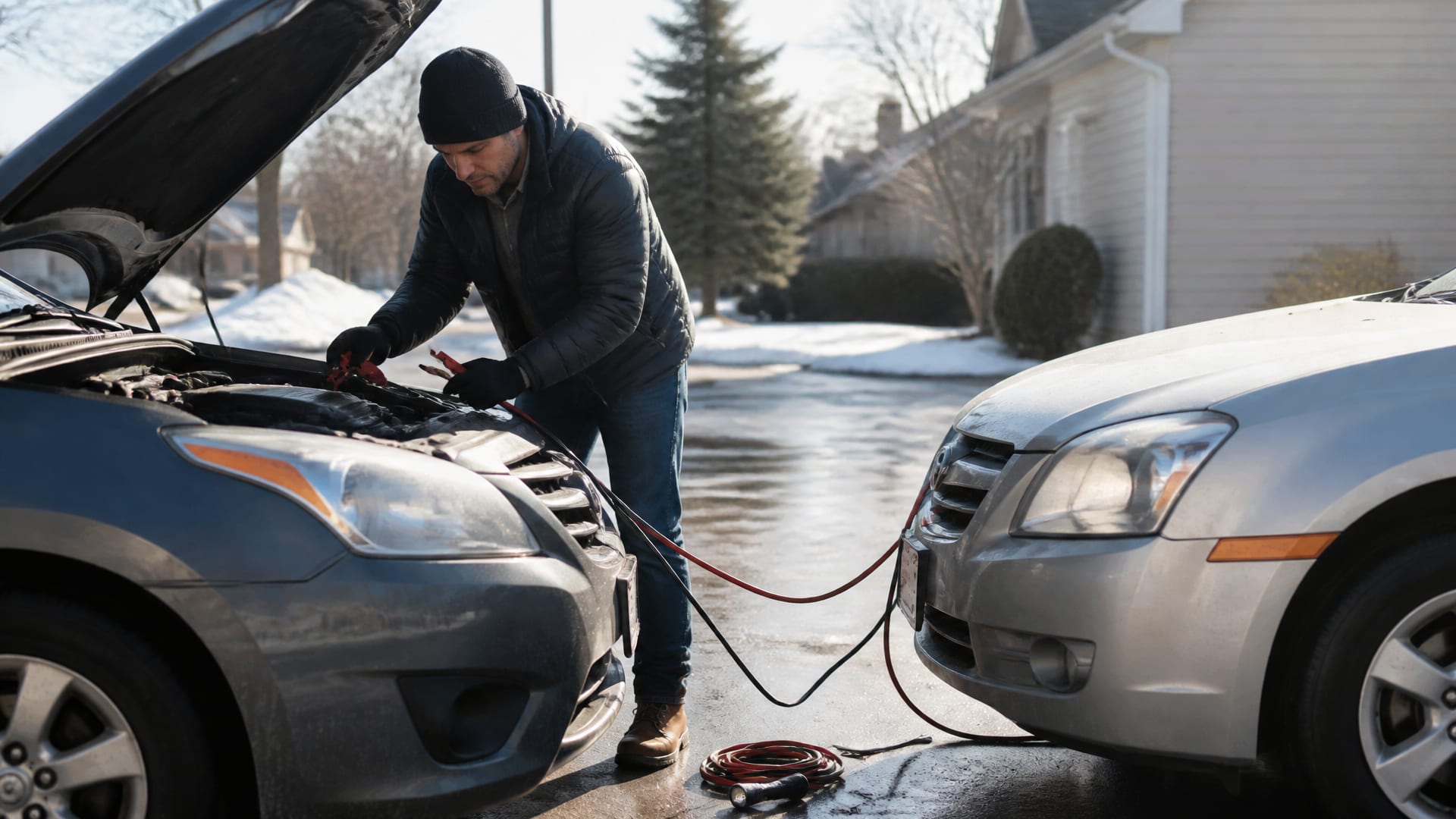
To learn how to jump start a car safely, attach the clamps in this exact jumper cables order: connect the red clamp to the dead battery’s positive (+) post, the opposite red clamp to the booster battery’s positive (+) post, and the black clamp to the booster battery’s negative (-) terminal. Finally, attach the remaining black clamp to an unpainted metal ground on the dead car’s engine block. Run the donor vehicle for 3 to 5 minutes, start the stalled car, and carefully disconnect in exact reverse order.
Your car clicks, but it won't start. That's a common dead car battery jump start moment, and you can usually handle it with what you already own: a set of jumper cables and another 12-volt vehicle. The safest approach is simple, though. Park both vehicles, match battery polarity carefully, connect the clamps in the proper sequence, and avoid attempting a jump if the casing looks damaged or if either vehicle is an electric vehicle with manufacturer restrictions. If you are wondering how to jump start a car safely with cables, the key is patience, not force. A wrong connection can spark, fry delicate vehicle electronics, or turn an easy roadside issue into an expensive towing bill.
Quick Reference Safety Checklist
- Use a healthy 12-volt donor vehicle; check owner manuals before using a hybrid as a power donor.
- Attach red to positive first; connect black to bare unpainted metal away from the battery last.
- Allow the donor vehicle to idle for 3 to 5 minutes before cranking the stalled engine.
- If the battery case is cracked, swollen, leaking acid, or frozen solid, stop immediately.
- Keep the revived engine running for 15 to 20 minutes to allow the alternator to restore surface charge.
Essential Jump Starting Questions Answered
How do I jump start a car safely?
Start by parking the donor vehicle close enough for the jumper cables to reach comfortably without tension, ensuring the two cars never touch physically. Shift both transmissions into Park (or Neutral for manual gearboxes), engage the emergency parking brakes, and switch off both ignitions. Pop both hoods and locate the 12-volt battery terminals.
Connect the red clamp to the positive (+) post of the discharged battery, then connect the other red clamp to the positive (+) terminal of the donor battery. Next, clamp the black cable onto the negative (-) terminal of the donor battery. Fasten the final black clamp to an unpainted, solid metal component on the disabled car's engine block or frame bracket—never directly onto the negative post of the dead battery. Grounding away from the terminal minimizes hydrogen gas spark hazards, which is why official safety guidelines emphasize grounding clamps away from lead-acid vents (AAA: How to Use Jumper Cables Safely; AAA: Connecting Cables to Lead-Acid Batteries).
Start the helper car and let it run at idle for 3 to 5 minutes to feed voltage into the depleted cells. Next, turn the key in the disabled vehicle. Once the engine catches, leave both vehicles running while detaching the clamps in precise reverse order. Following this method shields delicate alternators, onboard ECUs, and your hands on freezing winter mornings or hot summer afternoons.
Which jumper cable goes on first?
To follow the correct protocol for which jumper cable goes on first, always attach the red positive cable first. Clamp it onto the dead battery's positive (+) terminal before handling the remaining connections. Attach the second red clamp to the booster car's positive (+) post, followed by the black negative clamp on the booster battery, ending with the final black negative clamp grounded to bare metal on the dead vehicle. This sequence eliminates accidental short circuits against vehicle body panels.
Remember this golden rule: positive first, negative last. A standard battery post is identified by a plus sign (+) or red plastic cover, while the negative post displays a minus sign (-). If terminals are coated in white corrosion or blue sulfate powder, wipe them clean with a dry rag before attaching your clamps. A reliable 4-gauge to 6-gauge heavy-duty cable set provides sufficient conductivity to crank light trucks, sedans, and SUVs reliably.
What should I not do when jump starting a car?
Knowing what should I not do when jump starting a car prevents personal injury and electrical damage. Never allow the red and black metal alligator clamps to touch each other while connected to any battery. Avoid leaning directly over lead-acid battery caps while making the final ground connection. Never attempt to boost a battery that is visibly cracked, swollen, leaking fluid, emitting sulfuric odors, or frozen solid, as introducing current can trigger an explosion.
Avoid roadside jump-starting when parked on high-speed shoulders, blind curves, or heavy traffic lanes without adequate safety clearance. Emergency roadside operators recommend calling professional dispatch services rather than attempting DIY steps in hazardous roadway conditions (AAA Roadside: Jump-Starting Protocol & Safety). Furthermore, avoid cranking the dead car's starter for longer than 10 seconds at a time; extended cranking overheats starter motors and rapidly drains the donor car's electrical reserves.
Can you jump start a car with a hybrid?
When asking can you jump start a car with a hybrid, the answer is yes with restrictions: a standard gas car can jump-start a hybrid's 12-volt auxiliary battery, but you should generally avoid using a hybrid to jump-start another conventional gas car unless your vehicle manual explicitly approves it. A hybrid’s auxiliary 12-volt battery is designed to boot electronic control units, not to supply the massive hundreds-of-amps surge required to turn over a heavy internal combustion engine.
Always check your vehicle manual for designated jump-start terminals located inside under-hood fuse boxes. Never attach jumper cables to bright orange high-voltage cables or the main hybrid traction battery. When dealing with specialized hybrid configurations in extreme desert heat or winter cold, utilizing a portable lithium jump-starter pack or calling roadside assistance is the safest choice.
How long should I run my car after a jump start?
Knowing how long should I run my car after a jump start prevents immediate re-stranding. Run the engine for at least 15 to 20 minutes continuously, preferably taking it for a highway-speed drive rather than idling in a driveway. Driving at normal operating speeds keeps engine RPMs high enough for the alternator to replenish the battery's surface charge efficiently.
Do not switch the ignition off immediately after moving the car a few feet. If the car dies instantly once disconnected from jumper cables, your vehicle likely has a faulty alternator that cannot produce running voltage. If the vehicle runs smoothly while driving but fails to start after being turned off, the battery has likely lost its ability to hold a charge.
How can I tell if the battery is dead or the alternator is the issue?
To accurately tell if battery is dead or alternator failure is the culprit, monitor how your vehicle behaves before and after the engine turns over. If the car cranks sluggishly, clicks rapidly, or was parked with interior lights on, the problem is usually a depleted battery that simply needs a full bench charge. However, if the engine cuts off while driving, dash lights flicker, or the battery warning dashboard light illuminates, the alternator has likely failed to generate sufficient operating voltage.
Most automotive parts stores offer free under-hood charging system diagnostics with handheld load testers. Testing both components before replacing parts prevents spending hundreds of dollars on a brand-new battery when a worn alternator belt, blown fusible link, or loose grounding wire is the true underlying cause.
Step-by-Step Cable Connection Guide
- Dead Car Positive: Attach the red clamp to the positive (+) terminal of the dead battery.
- Good Car Positive: Attach the opposite red clamp to the positive (+) terminal of the good battery.
- Good Car Negative: Attach the black clamp to the negative (-) terminal of the good battery.
- Dead Car Ground: Attach the opposite black clamp to an unpainted metal bracket on the dead car's engine block.
- Start & Charge: Run the donor car for 3 to 5 minutes, then start the dead car.
- Disconnect in Reverse: Remove black from metal ground → black from donor battery → red from donor battery → red from dead battery.
For more maintenance guides and roadside checklists, explore more Vehicle Care & DIY Maintenance Checklist tips.
Conclusion
Knowing how to jump start a car safely comes down to following strict connection sequences, respecting battery chemistry, and avoiding hazardous shortcuts. Keeping a reliable pair of jumper cables or a charged portable jump starter in your trunk ensures that a surprise dead battery remains a minor 15-minute delay rather than an expensive towing emergency.
Comments
Post a Comment
💡 You don't need an account! Select "Name/URL" or "Anonymous" from the dropdown to post.